What is gym etiquette anyway?

Sunday, November 23rd, 2008 | 4 Comments »

My first experience at working out in a gym environment was at the University of Iowa Fieldhouse[wiki]. In the midst of my awakening of understanding how to correct long standing health problems, this was my first, real experience at working out for personal health versus my short stint in my high school football program. To be honest, I think I’ve workout harder for my personal health than I ever did in the days when it meant being competitive, but that could just be a difference of time and mentality.

Regardless, there is one thing that you’ll find at any workout facility, and that is etiquette.

This shouldn’t prevent you from going to a gym or workout facility, but there are just some things that I’ve noticed over the past few months that consistently confound me.
(more…)

The reason I workout and living with Gilbert’s Syndrome

Tuesday, August 19th, 2008 | 9 Comments »

Rebecca did something pretty spectacular about a month ago. We’ve been working pretty hard on some projects with sixty4media in the last few months, so she asked what she could do to make it up to me. Working a full time day job, the only time I can get to these projects is in between work and sleep. So, I said that a gym membership would be nice, but she one upped me.

We now have one year memberships to Fitness World in exchange for reports on her progress with getting back into shape and an ad on her sidebar for the duration of the membership. That isn’t bad at all, so I figure I might as well add a bit to the one year deal and provide some feedback on my experience with their facilities and services.

To begin, I thought I would explain more of where my inspiration to workout comes from and why I go to the gym or run in the morning.
(more…)

Nalgene water bottles and possible health risks

Saturday, December 8th, 2007 | No Comments »

Water bottles that cause cancer

What a cruddy feeling it was to hear and read about this morning. I took a Nalgene water bottle up and down Mt. Fuji, not to mention all over the Kanto Plain while in Japan, and it was my best friend through my remainder days in college.

As with everything else in this world, they might cause cancer.

Mountain Equipment Co-op pulls Nalgene water bottles from shelves

VANCOUVER (NEWS1130) – Whether you drink it murky and straight from the tap or you take it filtered, there are new concerns today about water containers. One of the most popular refillable bottles has now been pulled from one store’s shelves.

Mountain Equipment Co-op will no longer sell the popular Nalgene bottle. That was supposed to be the healthy choice but now we learn it’s a product made with bisphenol A, which is a component studies have linked with higher cancer and disease risks. [...]

Health Canada is examining the risks but the findings won’t be available until at least late Spring. [news1130]

I bought the bottle in the picture above at Deakin Equipment during their fall clearance sale just a few months ago. I think we have a few other Nalgene bottles in the apartment, if not close look-a-likes.

Maybe it will turn out to be nothing, but it’s certainly something that you don’t want to hear about when you drink at least two or three, full refills of water out of this bottle nearly everyday. I’m really inclined to wait for more word on the situation before I think about using my lovely, beloved Nalgene bottle again.

SiCKO and the American health care debate

Friday, July 27th, 2007 | 5 Comments »

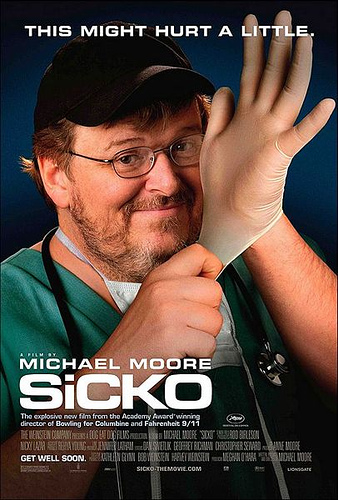
sicko.jpg Since I watched SiCKO[imdb] the other night, I figured I would loft some thoughts out about it. It’s not easy because I certainly have an appreciation as much as a total annoyance with Michael Moore[wiki]. It’s nothing politically related, just a matter of preference. He’s good at what he does, but there is a certain point where you just want stop watching or listening to the guy for the sake of enjoying the silence.

Overall, a pretty good movie. Even being a documentary, it entertains as well as educates people on the reality of the health care system in the states. Being in Canada, there are people here that are surprised by it. It’s rare, but some folks, even this close to the border, have no frame of reference as to the state of the system in the U.S.

“But you guys are supposed to be one of the richest nations in the world.”

I’m not going to get too deeply into that statement, but the reality of it should give any American a reason to say, “Yeah, you know, you’re right. But why don’t I have any health care coverage unless I have a sweet job with sweet benefits?”

I had a job with the University of Iowa, a state owned and funded institution, for nearly a year before I started to display my lack of satisfaction with the position I had. Being a broadcast engineer, I was working with high voltage equipment on a regular basis. I even crunched my hand under a 200-pound power supply to a FM transmitter, covered by workman’s compensation but no broken bones or bleeding.

It was that instance that freaked me out. You’re told how vital you are to an operation like that, but working in the most hazardous position in the whole place, they never gave me medical coverage at the start. I mentioned that I was going to have to find something else with benefits, meaning leaving the stations. I had medical within a week or so after that, dental came a little while later.

michael-moore.jpg

My story pales in comparison to some, but it’s tough for nearly anyone. You can get any job anywhere, but the first question out of anyone’s mouth is, “Benefits?” Sometimes that American dream gets limited by what job you can or can’t do simply by working the job you hate because it has more benefits than the job you want or love. It’s an awful catch.

The one point that I constantly point out to people about this subject is that the main reason we don’t have anything protecting the health of the U.S., such as a universal or socially controlled medical program, is taxes. That American dream is the ability to have whatever you want, as much as you want, and the opportunities are, supposedly, limitless to achieve it.

But don’t you dare make Americans pay taxes. No one wants to pay extra money to the government for anything, even if that means that universal health care coverage would mean anyone working a white collar job to the three part-time jobs, single mom of two kids would have the same amount of medical coverage in the event that either of them contracted a life threatening illness like cancer or TB. The only difference between those two people being socio-economic status, and there is a good chance, rich or lower class, neither would budge on the thought of giving more of their money to the government in exchange for free health care or reduced cost of medication.

That’s when the title of SiCKO starts to make sense to me. It’s a sick circle that the U.S. has gotten itself into. I would love for it to change, but that would really take a revolution of a magnitude that I can’t fathom. That’s not to say that the system here in Canada is the perfect example of what to do, but there isn’t far to look for the positive effects this could have for an entire nation. After all, wouldn’t it be nice if the government cared more to spend money on its own people?

Got a case of the shin splints

Thursday, July 19th, 2007 | 3 Comments »

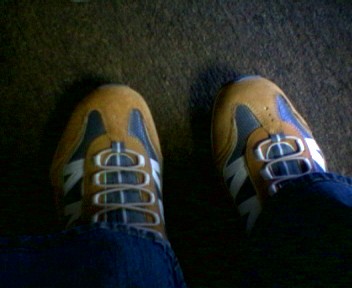
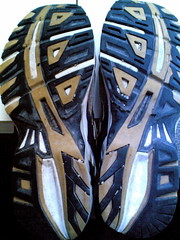
Runner Shoes (250+ miles overdue for change) Actually, it’s more like I have a shin splint[wiki], just in my left calf. It’s been with me for about a week, but the ache won’t go away. You tend to do the stupid thing and just consider it a tired muscle, but I’ve taken the last few days off from my routes.

Rebecca set to the Google this morning and found that you should replace your running shoes every four hundred miles. I’ve often considered the every six months rule, so we did a little math.

I’ve had these current pair of shoes since my birthday, last September, but started using them in November. That makes it about eight months, so there’s strike one. Taking an average of running 10k for each day that I run, which is about three times a week, the roundabout total number of miles in this pair of runners is 600. Strike two.

Working the Google some more, I found this really good page about shin splints and running.

What Are They

Shin splints is a common term used for a half a dozen lower leg problems ranging from nerve irritations to tendonitis to stress fractures. The most common type that is experienced involves the tearing away of the muscle tissue that attaches to the front of the lower leg. The beginner runner and the runner that resumes training after a long lay off are most susceptible to this injury. The connective sheath attached to the muscles and bone of the lower leg become irritated, resulting in a razor-sharp pain in the lower leg along the inside of the tibia or shin bone. Shin splints can be felt anywhere from just below the knee down to the ankle. The pain may diminish after warming up but then returns a few minutes after the completion of a workout.

How Are They Caused

There can be several causes for shin splints. Only when possible causes are identified can shin splints be eliminated.

Possible causes include:

- Tight Achilles and calf muscles.
- An inexperienced runner just beginning to run.
- Running on uneven terrain.
- A sudden increase in faster running (speed work).
- A sudden change from soft to hard running surfaces.
- Running in worn down shoes.
- Excessive uphill running.
- Poor running mechanics which include excessive forward lean, excessive weight on the ball of the foot, running with toes pointed outward, landing too far back on the heels causing the foot to flap down, and overpronation. There is a drill that I do with my runners at Selah High School called silent running. I have them run on the track as quiet as possible. With the feet landing properly very little noise should be heard. Of all of the possible causes, pronation is the most likely to be overlooked, as it was for me in high school.

Strike three. I’ve got the worn down shoes combined with uphill running. I tend to pay a lot of attention to my mechanics, making sure that I take care of my knees in the long run. I’ve got the “silent running” thing down pretty well because I know that I’ve scared my share of people when I run up behind them and pass.

Getting new shoes is on the list of things to do very soon, but I’ll have to let this heal a little bit before getting back on the routes in full capacity. It’s not horrible as much as it’s just an annoying pain to have. Stretching and massage only does so much. Time is the only, real cure, but there are some other things I’ll try in the meantime.

What is runner’s high?

Wednesday, July 11th, 2007 | No Comments »

Oddly enough, I was actually thinking about this morning while I was running a long route of near 10k. Talking with Corinna about it, we couldn’t come up with a good understanding of what “runner’s high” is exactly.

I get the concept. It implies pretty much what it means, but I ventured to good ol’ Wikipedia to see what I could dig up. This is actually apart of the article for endorphin, the naturally occurring chemical in your body that is responsible for getting you “high”.

Another widely publicized effect of endorphin production is the so-called “runner’s high”, which is said to occur when strenuous exercise takes a person over a threshold that activates endorphin production. Endorphins are released during long, continuous workouts, when the level of intensity is between moderate and high, and breathing is difficult. This also corresponds with the time that muscles use up their stored glycogen and begin functioning with only oxygen. Workouts that are most likely to produce endorphins include running, swimming, cross-country skiing, long distance rowing, bicycling, weight lifting, aerobics, or playing a sport such as basketball, football(soccer), or American football. [wiki]

Ok, being the good neuroscience student that I was in college, I get what it is now. What I don’t know is if I’ve ever had it or what it’s like when you obtain this state of foot pounding zen.

The only thing I can think of coming close to this is not feeling the soreness in my legs as I start out compared to being twenty minutes into a route. To me, that’s just a sign of muscles loosening and warming up. Been doing a bit of swimming in the last few days, and I try to do some lunges and squats in between running days for a bit of resistance training. Even after running, I stretch out to prevent stiffness.

Runner’s high is said to make you not feel pain because, chemically, that’s what endorphins are designed to do. I’m just a little lost as to if I should be feeling happy, running faster, or having some sort of vision of colors, a la Stanley Kubrick’s 2001: A Space Odyssey[imdb]. I just don’t know what it actually feels like.

Oranges and bananas and running

Friday, May 4th, 2007 | No Comments »

When my parents came to visit, they brought something into our house that we haven’t seen enough of around here. Fruit. What they left behind has been a incredible discovery that I should have seen or been aware of for a long time. Oranges and bananas are great post run foods.

I thought about looking around to see what I could find out about this, and here is my “duh moment” for today.

In general, most endurance athletes should eat a diet that is composed of 55 to 65 percent carbohydrates. Bread, rice, potatoes, pasta, fruits, energy bars and vegetables are excellent choices for your post workout meal. Potassium rich foods such as bananas and oranges will help replace lost electrolytes. This is important, because low electrolytes have been linked to muscle cramping. Consuming protein along with carbohydrates can stimulate glycogen replacement. Active individuals should consume 10 to 15 percent of their calories from protein, or 0.5 – 0.8 grams protein per pound body weigh It will also help repair damaged muscle tissue. If you are staying away from animal products, you can get protein from beans, legumes and soy products. In addition to carbohydrates and protein, be sure to consume plenty of fluids in the form of either water or fruit juice. [mamashealth]

Sure, it’s a women’s health site, but I’ve found more, useful information that has aided my health from sources like this. Regardless, I’ve also noticed a slight increase in craving fruit during and post run. I think since I’ve made the conscious link to the source of goodness for my body, my brain is yearning for the nourishment as soon as it can get me directed on the route home.

I’m going to have a banana now. The 10k this morning in this beautiful Vancouver weather was astounding.

Side stitches while running

Thursday, April 12th, 2007 | 3 Comments »

Ok, I’ll admit it. I listen to a fitness podcast. Does that really surprise you though? I like to be somewhat healthy, mainly for combating my Gilbert’s Syndrome[wiki]. It also helps that running bug that I have. (Although, with my parents coming to town this weekend, I won’t be doing the Sun Run this year, not that there aren’t a billion other running events that I can do this summer in Vancouver.)

Listening to the Fitness Attack the other day, this episode caught my attention because any runner can relate to the topic of those cramps you get in your side. I always called them “side cramps”, but the term “side stitch” is a newer one to me. I like that one better, so from now on, that’s what I’ll call them.

You can listen to the 60 second episode yourself, but I transcribed the tip below for my own purpose. If you are a regular runner or person who exercises, you might be able to use this or even expand upon the topic.

One common and annoying problem that can develop during exercise is a sharp, stabbing cramp you might feel just under the lower edge of your rib cage, known as a side stitch. One way to over come this is to perform deep, belly breathing by maintaining a strong, core muscular system. You can minimize the appearance of this exercise related, transient related abdominal pain, and leave the stitches to the tailors and the surgeons. [fitnessattack]

I don’t get them a lot, but my mental mantra while running is that I don’t stop to walk unless I feel pain or the urge to throw up. Gross, I know, but you can’t simply stop when tired if you’re a more seasoned runner. When I get tired, then I’ll slow up my pace to a slow trot, but the point is to keep moving. It’s usually that first 20-30 minutes that is always the hardest, and if a side stitch pops up on me, then it’s around that time, maybe once every three weeks.

Exercise helps decrease your risk of getting colds

Thursday, October 26th, 2006 | No Comments »

I knew the miles upon kilometers of pavement and trails weren’t all for nothing. Now that science says it’s true, then you have to believe it.

WASHINGTON (Reuters) – A long-term moderate exercise program can reduce the risk of colds among older women, U.S. researchers said on Thursday.

In the first randomized clinical trial to investigate the impact of moderate physical activity on the common cold, researchers from the Fred Hutchinson Cancer Research Center found that post-menopausal women who worked out regularly had about half the risk of colds as those who did not exercise. [...]

The researchers found that the ability of moderate exercise to ward off colds seemed to increase over time. In the last three months of the study, the group of women who were only stretching were three times as likely to catch a cold as those who were exercising regularly. [...]

“With regards to preventing colds, it seems you really have to stick with exercise long term,” Ulrich said.

The results were seen as important in understanding the health benefits of exercise, Ulrich said.

“It may apply also to other age groups, it may apply to men,” she said. “In the past, immune studies have been quite consistent among men and women. I wouldn’t expect that to be different.” [reuters]

In the seven years that I’ve been running and working out, I find this to be pretty true. College is a petri dish of illnesses, and it seemed like it would be a yearly event that I would go through the various, air born whatever-it-was that was going around. My days prior to that were constant illnesses, some of them linked to a condition that I have called Gilbert’s syndrome[wiki]. It seemed that the “thing that’s going around” would always hit me about a week before it reached the masses.

Working out helps all of these things, not to mention the lack of colds. If and when I have colds now, it’s either very subtle or horribly painful. When something is able to break through your immune system and get you, chances are, you’re going to go down pretty hard. I probably make more effort to get sleep now compared to my high school and college days. That always helps.

Knock on wood, but it’s been nearly a year since I had a run in with a case of strep throat, the flu, and a sinus infection. Oddly enough, that was all a short time after I moved to Vancouver. I chalk that all up to being exposed to new surroundings and getting my initiation to the lower mainland. What a way to welcome me to my new home.